Repertoire guide
INREP and OUTREP
Choose the lines you want to practise, while keeping your alternatives available to explore. Both belong in your chapter; their membership determines whether they enter training.
INREP
These are your prepared lines: the moves you have chosen to play and remember.
An INREP line enters Learn while it has unlearned moves. Once learned, it enters Review when its schedule is due. You can also browse it in Analysis View.
OUTREP
These are saved alternatives: ideas, variations, or different move orders you want to examine.
They stay in Analysis View, including after you leave or refresh, and stay outside Learn and Review. The red styling marks their membership; an OUTREP move can still be a good chess move.
A simple example
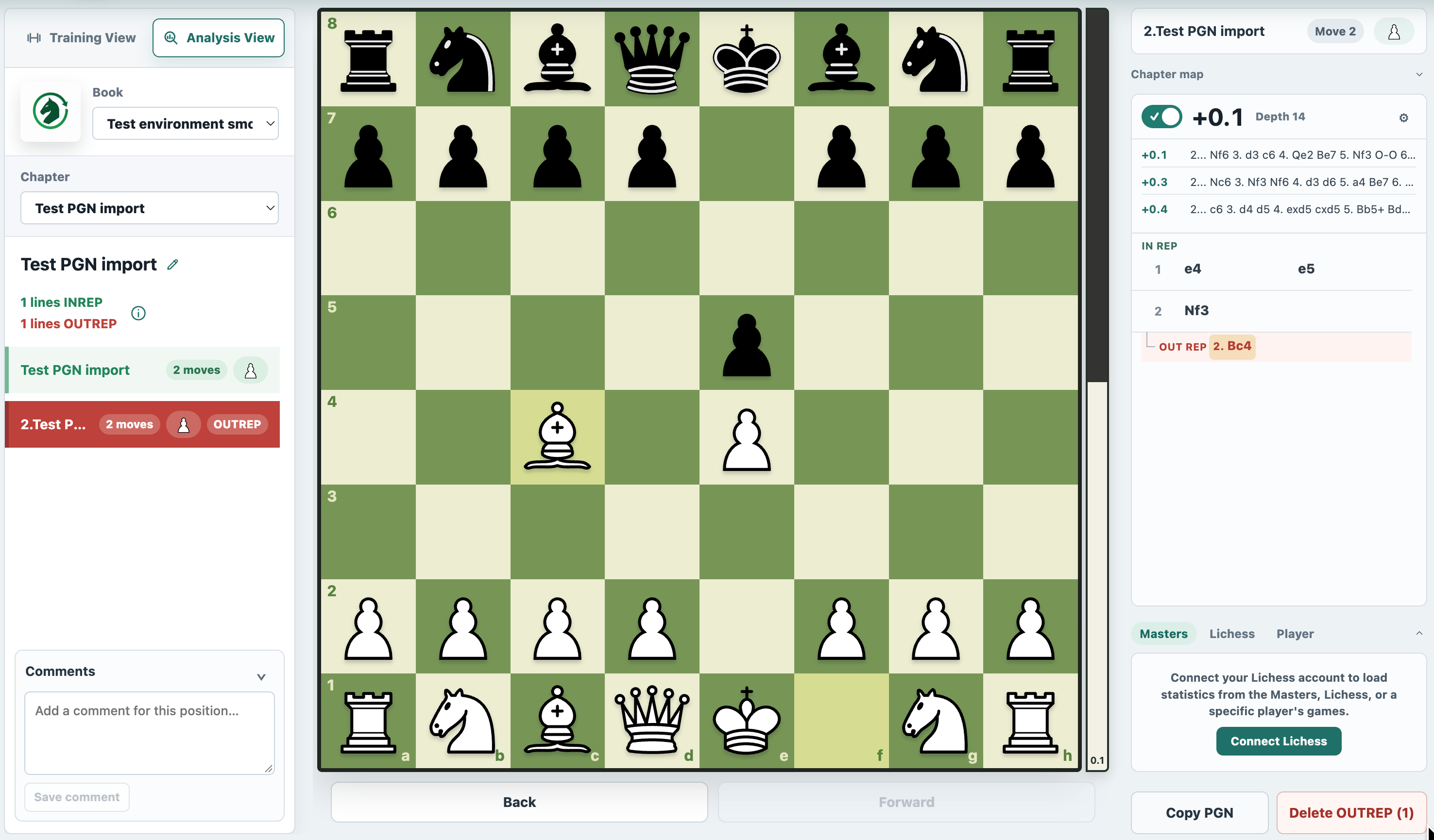
In a White book, suppose you prepare 2. Nf3 after 1. e4 e5, but also want to investigate 2. Bc4.
You practise the Nf3 line and keep the Bc4 line available for comparison. Choose Add to Rep if you later decide to prepare Bc4 instead.
Changing what you train
- Explore in Analysis View. New lines you create by playing analysis moves are saved as OUTREP, so exploring does not automatically add work to your training queue.
- Choose Add to Rep. Open the line's context menu to make it INREP. A new line starts at Level 0 with unlearned moves. Adding a continuation to an existing prepared line keeps its existing progress and makes the appended moves ready to learn.
- Choose Remove line to pause training that line. In the repertoire context menu, this changes it to OUTREP. Its saved moves and learning progress remain. Re-adding the saved line retains its Level and schedule. Delete line is the separate action that removes its saved record.
One prepared response for your colour
At a position, OpeningReps keeps one INREP response for the colour of your book. Adding a competing response opens a confirmation. If you confirm, the competing prepared response and its saved downstream lines become OUTREP, keeping them available for analysis.
Your opponent can have several replies in the repertoire. For example, a White book can prepare responses to both 1... e5 and 1... c5 after 1. e4.
When you import a PGN
When the PGN offers alternatives for your book's colour at a position, the first response stays INREP. The alternative responses and their continuations become OUTREP. Opponent branches can stay INREP unless they are already inside an OUTREP variation.
Transpositions import with a warning. When different move orders reach the same position, the first INREP path keeps its continuation. Other paths stay INREP through that position, and their continuations become OUTREP for review in Analysis View. This also applies when the continuations play the same move.
After import, an Analysis View dialog explains the choice. Adding an OUTREP continuation to INREP asks for confirmation before making the competing continuation OUTREP. Paths up to the transposition and saved progress are retained. Cancelling the confirmation changes nothing.
The counts beside the chapter title show its INREP and OUTREP lines. They describe training membership, independently of which line you select or which path is displayed as the PGN main line.